 English
 中文简体
 Español
 عربى


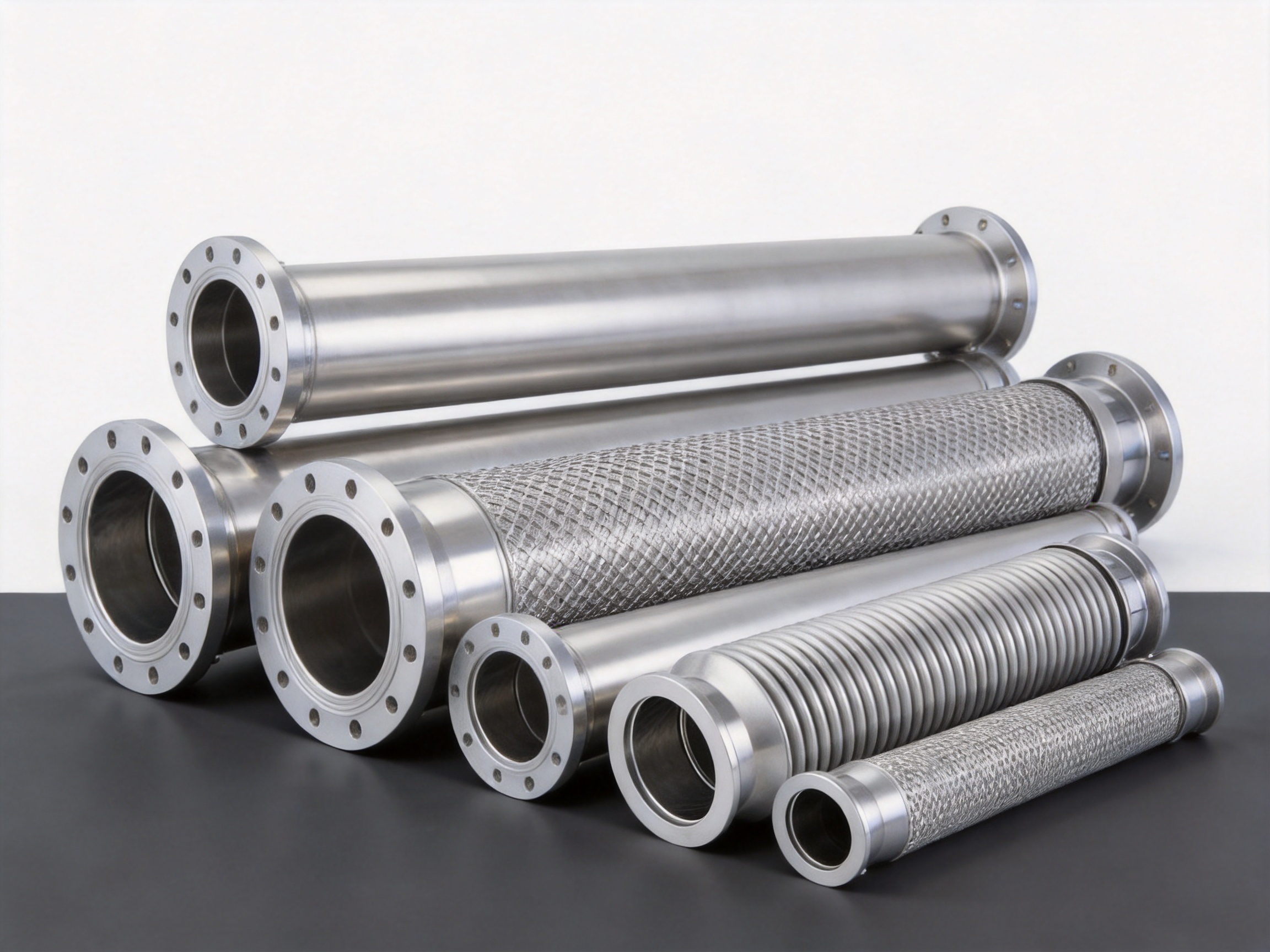
Modern vacuum systems depend on more than pumps, valves, and rigid pipework. Flexible connections are equally important because they absorb equipment movement, compensate for installation tolerances, reduce vibration transmission, and simplify maintenance. In demanding gas, water, industrial, and process applications, the hose must remain mechanically stable while preserving system cleanliness and leak tightness. The ISO-K Flange-Type Stainless Steel Vacuum Hose is designed for this role, combining a stainless steel corrugated hose body with ISO-style flange connections and an optional stainless steel mesh sleeve.
This product is intended for industrial users who require dependable vacuum-to-atmospheric-pressure service, controlled leakage performance, corrosion-resistant materials, and flexible installation. It is available in standard bore sizes from 65 mm to 150 mm, with larger dimensions available by request. Standard lengths range from 200 mm to 5,000 mm, while custom lengths can also be manufactured to meet specific equipment layouts.
The hose is manufactured from SUS304 or SUS316L stainless steel. The flange and mesh sleeve can also be produced in SUS304 or SUS316L, allowing the material selection to be matched to the process environment. Depending on the construction, the hose may be supplied as a non-mesh vacuum hose or as a vacuum hose protected by a stainless steel braided mesh sleeve.
Content
- 1 Product Overview
- 2 Key Construction Features
- 3 Standard Technical Specification
- 4 Standard Size Range
- 5 Advantages Compared with Conventional Alternatives
- 6 Manufacturing Process and Quality Control
- 7 Manufacturing Capability and Company Strengths
- 8 Application Areas
- 9 Installation Recommendations
- 10 Maintenance and Service-Life Considerations
- 11 Selection Guide
- 12 Customization and Engineering Support
- 13 Why This Product Is a Strong Industrial Choice
- 14 Questions and Answers
- 14.1 What is the primary purpose of an ISO-K flange-type vacuum hose?
- 14.2 What materials are available?
- 14.3 What pressure range does the product cover?
- 14.4 What leak rate can be achieved?
- 14.5 When should the mesh-sleeved version be selected?
- 14.6 Are custom hose lengths available?
- 14.7 Can the hose be used in dynamic applications?
- 14.8 How should the hose be installed?
- 14.9 How does stainless steel compare with polymer hose in vacuum service?
- 14.10 What quality-control resources support production?
- 14.11 Is SUS316L always better than SUS304?
- 14.12 What information should be supplied when requesting a quotation?
- 15 Conclusion
- 16 References
- 17 Product: ISO-K FLANGETYPE
Product Overview
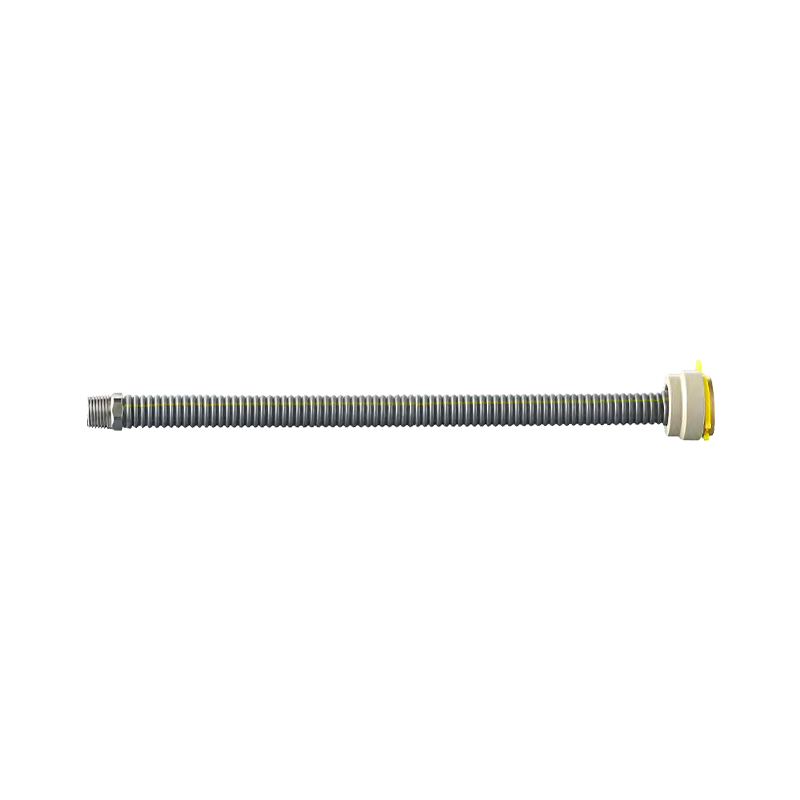
The ISO-K Flange-Type Stainless Steel Vacuum Hose is a flexible metallic connection for vacuum lines and related industrial systems. Its principal components include a corrugated metal hose, end flanges, and, where required, a protective braided mesh sleeve. The corrugated structure provides flexibility and enables the hose to accommodate movement that rigid pipework cannot absorb efficiently.
The ISO-K connection format supports integration with compatible vacuum components, including chambers, pumps, valves, elbows, reducers, and other flange-equipped assemblies. Because flange connections are standardized within the applicable vacuum system, installation can be faster and more predictable than fabricating special welded connections for every project.
The product is rated for service from vacuum to atmospheric pressure under the stated standard specification. The allowable leak rate is 1.33 × 10⁻¹⁰ Pa·m3/sec and below. This specification is important for applications in which pressure stability, process protection, and contamination control are essential.
Unlike a conventional rubber or plastic hose, a stainless steel vacuum hose offers a metallic flow path with strong resistance to aging, temperature-related deterioration, permeation, and many industrial environments. Compared with a rigid stainless steel pipe, it provides greater installation flexibility and can help reduce the transfer of mechanical vibration.

ISO-K FLANGETYPE
Key Construction Features
Corrugated Stainless Steel Hose Body
The corrugated hose body is the central flexible element. Its formed profile allows bending without requiring the entire assembly to behave like a straight, rigid tube. The corrugations also provide a controlled amount of axial and lateral flexibility when the hose is installed within its specified bending radius.
Stainless steel is well suited to vacuum service because it combines mechanical strength, cleanability, corrosion resistance, and comparatively low gas permeability. SUS304 is a widely used austenitic stainless steel for general industrial service. SUS316L contains molybdenum and has improved resistance to many corrosive environments, making it a valuable option for demanding process conditions.
The selected hose material should always be evaluated against the transported gas, temperature, pressure cycling, cleaning method, and external atmosphere. Material compatibility is not determined by pressure rating alone. A properly selected stainless steel grade can improve service life, reduce maintenance frequency, and protect the integrity of the vacuum process.
ISO-K Flange Connections
The flange ends provide a practical mechanical interface between the flexible hose and the rest of the vacuum system. ISO-K connections are commonly used in industrial vacuum equipment because they permit reliable assembly, disassembly, and component replacement. Their use also supports modular system design, allowing equipment layouts to be modified without replacing an entire pipeline.
Flange dimensions must be matched carefully to the mating components. The product range includes ISO63, ISO80, ISO100, ISO125, and ISO160 designations within the listed standard sizes. Correct alignment, suitable sealing components, clean flange faces, and evenly distributed fastening force are all necessary for achieving the intended leak performance.
Optional Stainless Steel Mesh Sleeve
A stainless steel mesh sleeve can be added when the hose requires greater mechanical protection or improved pressure-handling capability. The mesh helps distribute external forces over the corrugated hose and can provide additional resistance to abrasion, localized contact, and installation damage.
The mesh sleeve is especially useful where the hose may experience repeated movement, external rubbing, or pressure pulses. It can also help stabilize the flexible hose during operation. However, the mesh is not a substitute for correct routing, adequate support, or compliance with the specified minimum bending radius.
The supplied specifications distinguish between static and dynamic pressure performance and provide separate minimum bending radius values. This distinction is important because a hose installed once and left stationary experiences different mechanical stresses from one that moves repeatedly during operation.
Standard Technical Specification
| Item | Specification |
|---|---|
| Hose material | SUS304 or SUS316L |
| Flange material | SUS304 or SUS316L |
| Mesh sleeve material | SUS304 or SUS316L |
| Operating pressure range | Vacuum to atmospheric pressure |
| Allowable leak rate | 1.33 × 10⁻¹⁰ Pa·m3/sec and below |
| Standard length range | 200 mm to 5,000 mm |
| Available construction | Non-mesh or stainless steel mesh protected |
The technical specification provides a foundation for selection, but it should not be treated as a substitute for application engineering. The actual suitability of a hose depends on gas composition, temperature, movement frequency, installation direction, vibration, pressure cycling, cleaning requirements, and the design of the connected equipment.
Standard Size Range
| Bore | ISO designation | D (mm) | d (mm) | T (mm) | D1 (mm) | Length L (mm) | Static pressure (MPa) | Dynamic pressure (MPa) | Static minimum bending radius (mm) | Dynamic minimum bending radius (mm) |
|---|---|---|---|---|---|---|---|---|---|---|
| 65 | ISO63 | 95 | 70.2 | 12 | 80 | 200–5,000 | -0.1 to 2.0 | -0.1 to 1.6 | 390 | 845 |
| 80 | ISO80 | 110 | 83.2 | 12 | 100.5 | 200–5,000 | -0.1 to 2.0 | -0.1 to 1.6 | 480 | 1,000 |
| 100 | ISO100 | 130 | 102.2 | 12 | 123 | 200–5,000 | -0.1 to 2.0 | -0.1 to 1.6 | 600 | 1,200 |
| 125 | ISO125 | 155 | 127.2 | 12 | 153 | 200–5,000 | -0.1 to 2.0 | -0.1 to 1.6 | 750 | 1,500 |
| 150 | ISO160 | 180 | 153.2 | 12 | 179 | 200–5,000 | -0.1 to 2.0 | -0.1 to 1.6 | 900 | 1,800 |
The dimensions shown above identify the principal standard range. The manufacturer can produce lengths not shown in the standard length column and can manufacture hoses with dimensions of ISO160 or larger. This flexibility is valuable for equipment builders and maintenance departments because hose length can be adapted to actual pipe routing rather than forcing an installation to conform to a limited catalog dimension.
Advantages Compared with Conventional Alternatives
Advantages over Rubber and Plastic Hoses
Elastomeric hoses are useful in many general-purpose applications, but they may have limitations in vacuum environments. Rubber and plastic materials can exhibit gas permeation, outgassing, aging, swelling, embrittlement, or loss of flexibility depending on the gas and temperature. They may also be more vulnerable to damage from ultraviolet exposure, cleaning agents, oils, or elevated process temperatures.
The stainless steel construction of the ISO-K hose provides a more stable metallic barrier. It is suitable for users who need a clean and durable connection with low allowable leakage. Stainless steel also offers a more predictable mechanical response across a broad range of industrial conditions, although exact temperature and chemical compatibility must be confirmed for each application.
Another advantage is dimensional stability. A metallic hose is less likely than many polymer hoses to deform permanently under mechanical loading or vacuum conditions. This helps preserve the intended internal passage and the alignment of the connected components.
Advantages over Rigid Pipework
Rigid pipework provides strength and dimensional accuracy, but it can transfer vibration directly from pumps and machinery to other parts of the system. It also requires precise fabrication and alignment. Even a small difference between the designed and actual position of two connection points can create installation stress.
A flexible metallic hose can absorb a portion of this movement and reduce the need for exact positional alignment. It can simplify pump connection, chamber connection, and equipment replacement. The hose may also help isolate vibration when installed correctly, reducing the risk that mechanical oscillations will affect sensitive equipment or loosen other connections.
Flexible hose should not be used to compensate for major misalignment, support heavy piping, or replace expansion joints without engineering review. Its advantage is controlled flexibility, not unrestricted movement. Proper supports and guides remain essential in every installation.
Advantages over Non-Flanged Custom Connections
Welded or specially fabricated connections can provide excellent performance, but they may require more installation time and specialized equipment. A flange-type hose offers a modular alternative. It can be installed, removed, inspected, and replaced with less disruption to the surrounding system.
The flange format also supports inventory management. Standard sizes can be stocked for common equipment interfaces, while custom lengths can be ordered when the layout requires them. This combination of standard connection geometry and flexible length improves project planning without eliminating customization.
Advantages of Stainless Steel Mesh Protection
When the application includes repeated movement, mechanical contact, or pressure pulsation, a mesh-sleeved hose may offer advantages over an unprotected corrugated tube. The braid helps distribute loads and protects the underlying hose from certain forms of external damage.
Mesh protection is also useful in installations where the hose is frequently handled during equipment service. Nevertheless, the mesh should be inspected periodically. Broken wires, severe flattening, corrosion, or abnormal deformation may indicate that the assembly has been exposed to loads beyond its intended service conditions.
Manufacturing Process and Quality Control
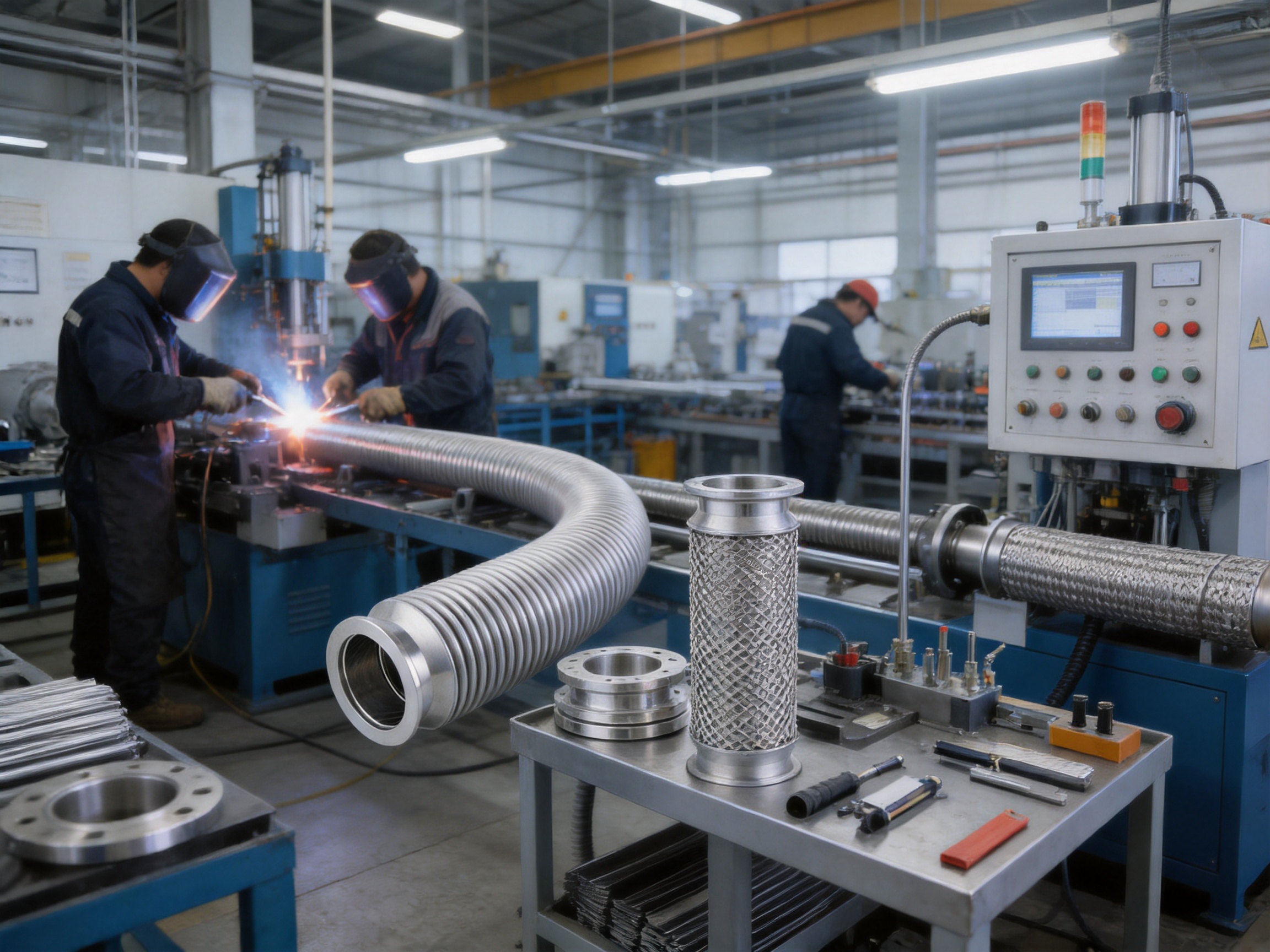
The performance of a vacuum hose is closely connected to the consistency of its manufacturing process. A leak-tight assembly requires more than high-quality raw material. Forming accuracy, welding quality, flange alignment, surface condition, cleaning, testing, and final inspection must all be controlled as part of an integrated production system.
Material Selection and Incoming Inspection
Production begins with stainless steel materials selected according to the required grade and component. SUS304 and SUS316L are used for the hose, flanges, and mesh sleeve according to the order specification. Incoming materials should be verified for dimensions, surface condition, material identification, and compliance with purchasing requirements.
Material analysis equipment, including direct-reading spectrometers, supports identification and verification of metallic composition. This type of inspection is important because stainless steel grades may appear similar while offering different corrosion resistance and process suitability. Confirming the material before forming and welding helps reduce the risk of traceability errors.
Forming and Corrugation
The hose tube is formed into a corrugated structure through controlled manufacturing operations. The geometry of the corrugation influences flexibility, pressure resistance, fatigue behavior, and vacuum performance. Consistent forming helps ensure that the hose bends uniformly rather than concentrating stress in isolated areas.
Manufacturing lines dedicated to welding and forming allow production parameters to be standardized and repeated. Process control is especially important for larger bore sizes because the dimensions and mass of the components increase the mechanical demands placed on forming equipment.
After forming, the hose should be inspected for dimensional accuracy, surface defects, incomplete forming, sharp edges, and irregular corrugation. Any abnormality that could create a stress concentration or a leak path must be addressed before the assembly proceeds to the next stage.
Welding and End Preparation
Welding joins the hose body to the end components and creates the pressure boundary of the assembly. The quality of the weld affects both mechanical integrity and leak tightness. Controlled welding procedures help limit distortion, maintain alignment, and reduce the risk of porosity or incomplete fusion.
End preparation is equally important. The flange must be positioned concentrically and at the correct angle relative to the hose axis. Poor alignment can create installation stress, interfere with sealing, and make it difficult to connect the assembly to mating equipment.
Manufacturing personnel with experience in stainless steel welding can select suitable procedures for the material grade and component thickness. Inspection may include visual examination, dimensional checks, and leak testing. Additional examination methods can be applied when required by a project specification.
Mesh Braiding and Assembly
For mesh-protected versions, the stainless steel braid is installed over the corrugated hose and secured as part of the end assembly. The braid must be positioned evenly so that it does not create localized pressure or interfere with the flexibility of the hose.
The construction should allow the hose to bend within its designated radius without causing the braid to slide excessively or become sharply distorted. The finished assembly is checked for braid coverage, end retention, surface condition, and compatibility with the flange arrangement.
Cleaning and Surface Control
Vacuum components require careful control of contamination. Oil, dust, metallic particles, moisture, and processing residue can affect pump-down time and process stability. Stainless steel components should therefore be cleaned using procedures suitable for the intended service.
The exact cleaning method depends on the customer’s requirements and the gases or materials that will pass through the system. In some applications, cleaning may include degreasing, rinsing, drying, and protected packaging. Clean handling after final inspection is also important because an otherwise clean hose can be contaminated during storage or transport.
Leak Testing
Leak testing is a central quality-control activity for this product. The stated allowable leak rate of 1.33 × 10⁻¹⁰ Pa·m3/sec and below represents a stringent requirement for vacuum equipment. Testing confirms that the hose body, welded joints, flange interfaces, and other potential leakage paths meet the required standard.
Flow tightness testers and other appropriate inspection instruments support the verification process. Test records can help establish traceability and provide customers with greater confidence in the consistency of the supplied assemblies.
Final Inspection and Packaging
Final inspection should include a review of overall dimensions, flange condition, hose length, material designation, mesh condition where applicable, and surface cleanliness. The product should be protected from impact and contamination during packaging.
Proper packaging is particularly important for flange faces. Scratches, dents, or foreign particles on the sealing area may affect installation and leak performance even when the hose itself has passed factory testing. Protective covers and suitable wrapping help preserve the condition of the assembly until it reaches the installation site.
Manufacturing Capability and Company Strengths
The manufacturer operates as an integrated energy-equipment production and trading enterprise with capabilities covering research, development, manufacturing, and processing. Its product scope includes metal hoses, natural gas pipelines, plumbing fittings, sanitary products, valves, plastic products, and hardware. This broad industrial background supports an understanding of how flexible hose assemblies interact with complete piping systems.
The production site covers approximately 40 acres and includes a factory building of about 30,000 square meters. The company operates 30 welding and forming production lines. This scale supports repeatable production, product diversification, and the ability to handle both standard orders and customized requirements.
In addition to welding and forming equipment, the facility includes uninterrupted solid-melting hydrogen furnace production lines. These resources contribute to the company’s metal-processing capabilities and support the production of components requiring controlled material treatment.
The company also maintains testing equipment such as direct-reading spectrometers for metal material analysis and flow tightness testers for leakage evaluation. These instruments are valuable because product reliability depends on both material accuracy and finished-assembly performance.
A strong manufacturing organization is not defined only by its equipment list. It also depends on technical personnel, documented procedures, process discipline, production planning, inspection records, and responsive customer service. The company’s research, design, and production team supports product development and application assistance from initial selection through after-sales service.
The company reports implementation of the ISO9000:2008 quality management system, possession of a special equipment manufacturing license for pressure pipelines in the People’s Republic of China, and EU CE certification testing reports. These credentials and systems indicate an organized approach to manufacturing and compliance. Customers should still confirm the specific certificates, test records, and applicable standards required for their own project.
Application Areas
Vacuum Pumps and Pump Inlet Connections
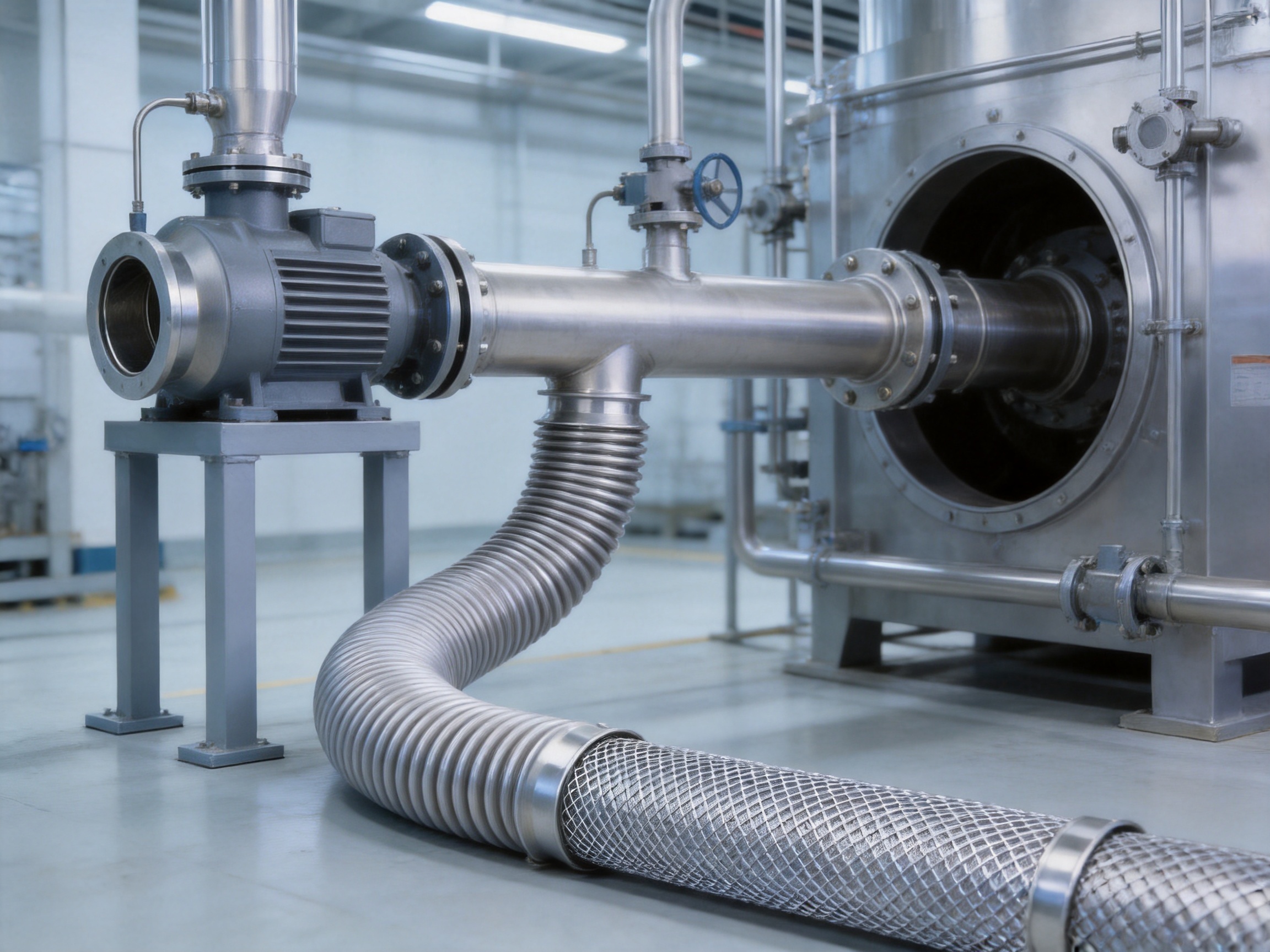
Vacuum pumps can generate vibration and movement during operation. A flexible stainless steel hose between the pump and the fixed vacuum line can help reduce the transmission of mechanical vibration and compensate for small installation differences. The hose should be supported so that the pump connection does not carry the weight of adjacent piping.
Vacuum Chambers and Process Equipment
Chambers often require access for cleaning, maintenance, or product changeover. A flanged flexible hose can make disconnection and reconnection more convenient than a permanent rigid connection. The stainless steel construction is also suitable for systems where cleanliness and low leakage are important.
Industrial Gas Systems
The hose can be considered for industrial gas lines when the gas, pressure, temperature, and material compatibility are confirmed. SUS304 and SUS316L provide options for general and more demanding corrosive environments. The flange configuration supports modular connection to valves, regulators, manifolds, and other gas-handling equipment.
Manufacturing and Process Automation
Automated machinery may move relative to fixed supply lines. A flexible hose can accommodate controlled motion and simplify equipment layout. For dynamic service, the larger dynamic bending radius shown in the specifications must be respected. Repeated movement should be evaluated according to stroke, frequency, bend direction, and expected service life.
Water and Utility Equipment
Although the product is particularly suited to vacuum and industrial applications, stainless steel flexible hoses can also be used in utility systems where a clean, corrosion-resistant, flanged connection is desired. The operating pressure, water chemistry, temperature, and movement conditions should be verified before selection.
Natural Gas and Energy Equipment
Energy equipment often combines vibration, temperature variation, and strict requirements for connection reliability. A correctly selected metallic hose can provide flexibility between equipment components while maintaining a robust metallic flow path. For combustible or regulated gases, the complete assembly must be evaluated under the relevant safety and certification requirements.
Installation Recommendations
Confirm Compatibility Before Installation
Before installation, verify the nominal bore, flange designation, flange dimensions, sealing arrangement, material grade, hose length, and pressure rating. Confirm that the hose is intended for the actual gas or fluid and temperature range. If the application includes corrosive chemicals, oxygen-enriched service, or repeated dynamic motion, consult the manufacturer or a qualified engineer.
Inspect the Hose and Flanges
Examine the assembly for shipping damage, dents, broken mesh wires, contamination, flange deformation, or scratches on sealing surfaces. Do not install a hose that has been sharply kinked or flattened. Damage that appears minor externally may affect the corrugated pressure boundary.
Use Proper Supports
Flexible hoses should not be used as structural supports for heavy valves, pipes, or equipment. Adjacent pipework should be independently supported. Proper supports prevent the hose from carrying loads for which it was not designed and reduce the risk of excessive bending at the flange connection.
Respect the Minimum Bending Radius
The minimum bending radius is a critical design parameter. The hose must not be forced below the stated static or dynamic value. Dynamic service generally requires a larger radius because repeated bending causes fatigue. The hose should also be routed without twisting, because torsional stress can shorten service life and affect the flange connection.
Align Flanges Naturally
Flanges should meet without forcing the hose into position. Do not use bolts to pull misaligned piping into alignment. This practice can introduce permanent stress and reduce the available movement capacity of the hose. If the flanges do not align naturally, correct the surrounding pipework or revise the support arrangement.
Use Suitable Seals and Fasteners
The sealing material and fasteners must be suitable for the process, pressure, temperature, and vacuum level. Flange bolts should be tightened in a balanced sequence using appropriate torque control. Excessive tightening can damage seals or deform components, while insufficient tightening can result in leakage.
Protect Against External Damage
Keep the hose away from sharp edges, hot surfaces, moving machinery, and chemical splashes unless the assembly has been specifically selected for those conditions. Where external contact is possible, use suitable guards or revise the routing. A mesh sleeve offers additional protection but does not eliminate the need for careful installation.
Maintenance and Service-Life Considerations
Routine inspection should be included in the maintenance program for the connected equipment. Inspection intervals depend on the operating environment, movement frequency, pressure cycling, and consequences of failure. High-cycle or safety-critical installations require more frequent evaluation than stationary, low-stress installations.
Inspect the corrugations for flattening, cracks, abnormal wear, discoloration, or corrosion. Check the mesh sleeve for broken wires, separation, severe abrasion, and localized deformation. Examine flange faces and fasteners for damage or loosening. Any unexplained change in vacuum performance should prompt an investigation of the hose and all adjacent connections.
Leak testing can be performed during planned maintenance or when the system shows an increase in pump-down time or pressure loss. A failure to reach the expected vacuum level may result from the hose, flange seal, pump, valve, chamber, gauge, or another component. Systematic testing is therefore more reliable than replacing components without diagnosis.
Hose service life is influenced by more than calendar age. Repeated bending, thermal cycling, vibration, pressure pulses, corrosion, contamination, and improper support can accelerate wear. A hose that remains stationary in a clean environment may have a very different service life from one used in continuous dynamic motion.
Selection Guide
| Selection factor | Questions to evaluate | Product considerations |
|---|---|---|
| Bore size | What internal flow area is required? | Select the appropriate bore and ISO designation. |
| Material | What gas, fluid, temperature, and cleaning agents are present? | Choose SUS304 or SUS316L based on compatibility. |
| Construction | Is mechanical protection or dynamic stability required? | Consider a stainless steel mesh sleeve. |
| Length | What distance and movement must be accommodated? | Standard lengths are 200–5,000 mm; custom lengths are available. |
| Pressure | Is the service static or dynamic? | Use the applicable static or dynamic pressure specification. |
| Bending | Will the hose remain fixed or move repeatedly? | Respect the correct static or dynamic minimum radius. |
| Leakage | What vacuum tightness is required? | Use the specified allowable leak rate as a selection benchmark. |
The most effective selection process begins with a complete application description. Customers should provide bore size, connection standard, total length, working pressure, temperature, gas or fluid composition, movement pattern, installation orientation, and cleanliness requirements. This information enables the manufacturer to recommend the correct configuration rather than simply supplying the closest nominal size.
Customization and Engineering Support
Standard catalog dimensions are useful for common installations, but real equipment layouts often require special lengths or larger diameters. The manufacturer can produce lengths outside the listed standard range and can manufacture hoses with dimensions of ISO160 or larger. This capability allows the hose to be adapted to the equipment rather than requiring unnecessary pipe rerouting.
Customization may include hose length, material grade, mesh configuration, flange arrangement, and other dimensional details. Any modification should be reviewed for its effect on flexibility, pressure capability, leak rate, fatigue behavior, and installation clearance.
Engineering support is particularly important when the hose will experience continuous movement, large temperature changes, severe vibration, corrosive gases, or stringent cleanliness requirements. A technically correct selection can prevent premature failure and reduce the total cost of ownership.
The manufacturer’s integrated production model is beneficial in customized projects. Research and development personnel can communicate with design and production teams, while testing resources can be used to verify the finished assembly. This reduces the separation that sometimes exists between product design, manufacturing, and application support.
Why This Product Is a Strong Industrial Choice
The ISO-K Flange-Type Stainless Steel Vacuum Hose combines several advantages in one assembly: stainless steel durability, metallic vacuum integrity, standardized flange connection, optional braid protection, a broad bore range, and custom length capability. This combination makes it a practical solution for equipment manufacturers, system integrators, maintenance teams, and industrial end users.
Its principal competitive advantage is application flexibility. The hose can serve as a vibration-reducing connection, an alignment-tolerant component, a maintenance-friendly interface, or a protected flexible section in a larger pipe system. The same basic product family can be configured for stationary or dynamic service, depending on the selected dimensions and installation requirements.
Its second major advantage is manufacturing depth. The company has extensive welding and forming capacity, material-analysis equipment, flow-tightness testing resources, and experience across energy equipment and industrial piping products. These capabilities support consistent production and provide a foundation for custom engineering.
Its third advantage is the balance between standardization and customization. ISO-style flange interfaces make system integration more straightforward, while nonstandard lengths and larger dimensions can be produced when the project demands them. Customers do not have to choose between a rigid standard catalog item and a completely one-off assembly.
Finally, the product supports long-term operational reliability when correctly selected and installed. Stainless steel materials, controlled forming, quality welding, leak testing, suitable cleaning, and professional technical support all contribute to dependable performance.
Questions and Answers
What is the primary purpose of an ISO-K flange-type vacuum hose?
Its primary purpose is to provide a flexible, leak-tight connection between vacuum equipment and rigid piping or other flanged components. It can accommodate limited movement, reduce vibration transfer, simplify alignment, and support easier maintenance.
What materials are available?
The hose, flanges, and mesh sleeve can be manufactured from SUS304 or SUS316L stainless steel. The preferred grade depends on the gas or fluid, corrosion conditions, temperature, cleaning process, and project requirements.
What pressure range does the product cover?
The stated operating range is from vacuum to atmospheric pressure. The standard table also lists static pressure capability up to 2.0 MPa and dynamic pressure capability up to 1.6 MPa for the specified sizes. The applicable rating must be confirmed for the selected construction and service conditions.
What leak rate can be achieved?
The allowable leak rate in the standard specification is 1.33 × 10⁻¹⁰ Pa·m3/sec and below. Actual system performance also depends on the flange seals, connected equipment, installation quality, and testing method.
When should the mesh-sleeved version be selected?
The mesh-sleeved version is appropriate when additional mechanical protection, resistance to external contact, or improved stability during movement is needed. It is not a replacement for correct supports, suitable routing, or compliance with the minimum bending radius.
Are custom hose lengths available?
Yes. Standard lengths range from 200 mm to 5,000 mm, and lengths not shown in the standard table can be manufactured. Larger dimensions, including ISO160 or larger, are also available by arrangement.
Can the hose be used in dynamic applications?
It can be considered for dynamic applications when the movement pattern, pressure, bending radius, frequency, and expected service life are evaluated. Dynamic service requires the larger specified bending radius and careful avoidance of twisting or sharp directional changes.
How should the hose be installed?
The hose should be installed without twisting, forced misalignment, excessive bending, or unsupported external loads. Adjacent piping should be independently supported, flange faces should be clean, suitable seals should be used, and fasteners should be tightened evenly.
How does stainless steel compare with polymer hose in vacuum service?
Stainless steel generally offers lower permeation, improved resistance to aging and many process environments, good dimensional stability, and a clean metallic flow path. Polymer hose may still be suitable for other applications, but its compatibility and vacuum performance must be assessed carefully.
What quality-control resources support production?
The manufacturing operation includes welding and forming production lines, metal material analysis equipment, flow tightness testing equipment, and organized quality-management procedures. These resources support material verification, dimensional control, leak testing, and final inspection.
Is SUS316L always better than SUS304?
Not necessarily. SUS316L may be preferable in more corrosive environments, but the correct choice depends on the actual media, temperature, cleaning chemicals, external atmosphere, cost requirements, and applicable specifications. SUS304 remains a suitable and economical material for many general industrial applications.
What information should be supplied when requesting a quotation?
Provide the required bore and ISO size, hose length, material grade, mesh preference, working pressure, vacuum level, temperature, medium, static or dynamic service condition, movement details, flange requirements, and any cleanliness or certification requirements.
Conclusion
The ISO-K Flange-Type Stainless Steel Vacuum Hose is a purpose-built flexible connection for industrial vacuum and related piping systems. Its stainless steel corrugated body provides flexibility and durability, while the flange configuration supports modular installation and maintenance. Optional stainless steel mesh protection adds another level of mechanical defense for demanding service conditions.
The product range covers common bore sizes from 65 mm to 150 mm, standard lengths from 200 mm to 5,000 mm, and pressure specifications for both static and dynamic conditions. Custom lengths and larger dimensions expand its suitability for specialized equipment layouts.
Behind the product is an integrated manufacturing organization with welding and forming capacity, material-analysis equipment, leak-testing resources, research and development personnel, and experience across energy equipment and industrial piping. This combination of product design, production capability, inspection, and customer support gives users a practical source for both standard and customized hose assemblies.
When the correct material, size, mesh construction, pressure rating, bending radius, and installation method are selected, the hose can improve system flexibility, reduce alignment difficulties, support vibration control, and contribute to reliable vacuum performance. It is therefore a strong option for equipment builders and industrial operators seeking a durable, maintainable, and professionally manufactured flanged metallic hose solution.
References
1. Manufacturer-provided product specification for ISO-K Flange-Type Stainless Steel Vacuum Hose.
2. Manufacturer-provided standard size, pressure, and minimum bending-radius data.
3. Manufacturer-provided information concerning SUS304 and SUS316L construction options.
4. Manufacturer-provided information concerning welding, forming, material-analysis, and flow-tightness testing capabilities.
5. General engineering principles for metallic corrugated hoses, vacuum piping, flange installation, and flexible industrial connections.
6. General stainless steel selection guidance for industrial piping, vacuum equipment, and corrosion-resistant components.
7. General quality-management and industrial manufacturing practices applicable to pressure and vacuum hose assemblies.